ETA Calculator Pro: Preventing Ship Delays via Weather Routing (2026)
Frustrated with inaccurate ship ETAs? Learn the 2026 guide to preventing vessel delays through weather routing, ocean current calculations, and ETA calculators.

Introduction
(Perspective: Hifshan Riesvicky - Maritime Software Developer & Former Deck Officer)
Throughout my experience interacting with various maritime professionals, from deck officers to fleet managers, the most frequent complaint is always about the accuracy of the Estimated Time of Arrival (ETA). The scenario is always the same: the initial calculation on paper (or Excel) looks perfect, but out at sea, the ship arrives hours, if not days, late. This delay is not just a number on a screen; it creates a domino effect that destroys port berthing schedules, bunkering plans, crew rotations, and ultimately results in commercial losses due to demurrage fines.
The root cause of this "missed" ETA is none other than the forces of nature: extreme weather and ocean currents.
In the fast-paced commercial shipping world of 2026, relying on static ETA calculations without considering dynamic weather routing is a fatal mistake. In this article, I will break down the main factors causing delays and how we can prevent them using smart navigation techniques. If you haven't read the basics of these calculations, be sure to check our comprehensive guide on How to Calculate Ship ETA first.
To make things easier for those who need precision speed without the headache of manual timezone conversions, don't forget to utilize our free Ship ETA Calculator on this website.
Dissecting the Anatomy of Vessel Delays
Why is ETA so often inconsistent? Theoretically, the formula is very simple: Distance divided by Speed. However, the ocean is not a smooth highway. Below are the components that directly strike a blow to your ship's speed over ground (SOG):
1. Wind and Wave Factors
Wind resistance and wave resistance are the natural enemies of ship speed. When a vessel hits ocean waves head-on (head seas), the ship's resistance increases exponentially. The main engine continues to burn maximum fuel, but the actual speed (SOG) can drop by 15% to 30%.
Comparison table of wave effects:
| Sea Condition | Wave Direction | Estimated Speed Loss |
|---|---|---|
| Beaufort 3-4 | Head/Bow | ~ 5 - 10% |
| Beaufort 5-6 | Head/Bow | ~ 15 - 25% |
| Beaufort 5-6 | Following/Stern | ~ 2 - 5% |
Data: Industry average observation of general cargo ships.
2. The Impact of Adverse Ocean Currents
Just like running on a treadmill, if a ship maintains 12 knots in an area with a 2-knot adverse current, the actual SOG is only 10 knots. If your voyage distance is 500 Nautical Miles (NM), you will lose roughly 8 hours of time!
Always use modern navigational aids such as Current Atlases or the latest 2026 ECDIS (Electronic Chart Display and Information System) data to identify the presence of strong currents.
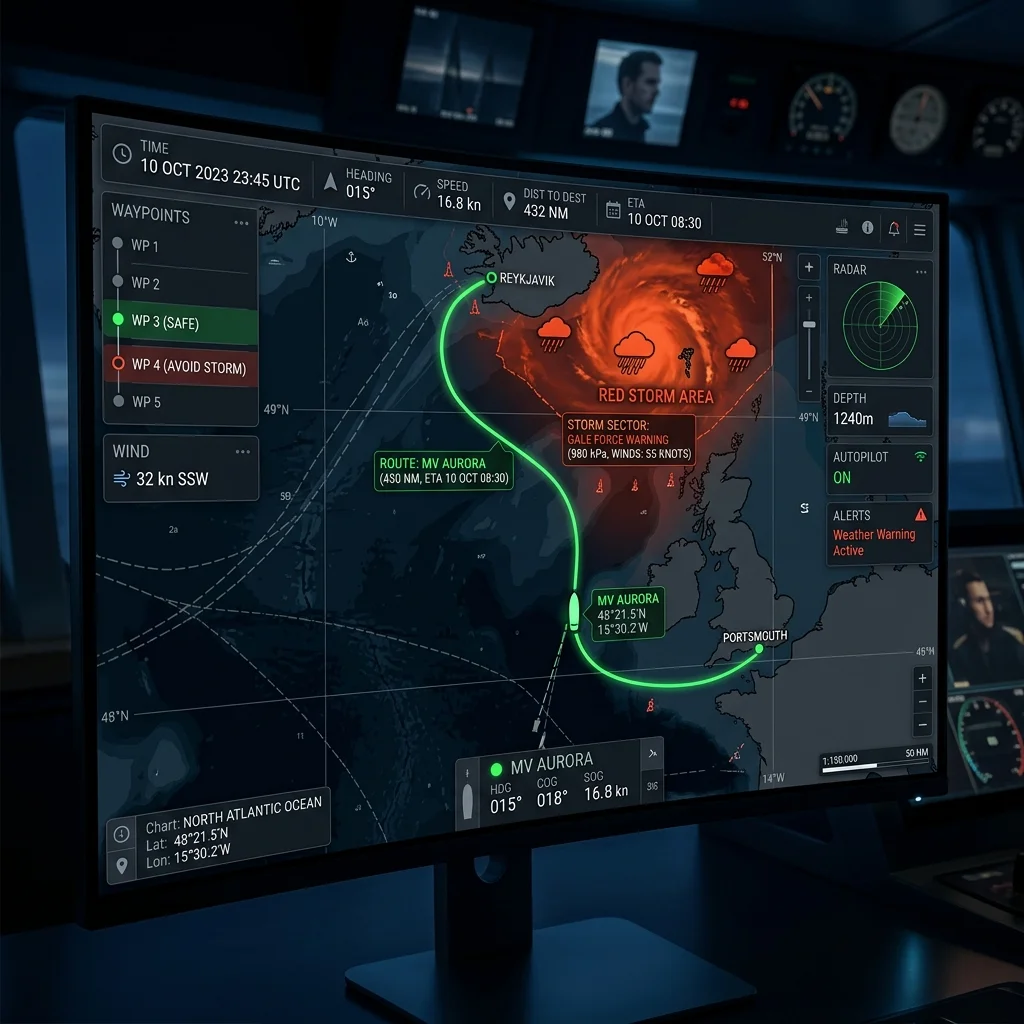
2026 Weather Routing Strategy: Optimizing Your Voyage
Weather Routing is not just about "avoiding storms"; it is the art of balancing time of arrival (ETA), safety, and fuel consumption. Let's look at its practical applications:
1. The Shortest Route vs. The Safest Route
The geodesic route (Great Circle) is the shortest path between two curves on the Earth. However, cutting through the shortest route across the ocean often forces a ship straight into storm fronts. In 2026, the best practice advises deck officers to use routes that detour slightly (longer in total NM), provided that the area offers following winds or significantly calmer seas.
The modern maritime paradox: Sometimes a longer route provides a faster ETA.
2. Dynamic Speed Allocation
Another frequent cause of delays is the failure to allocate a "speed buffer". If a ship has a constant maximum speed of 14 knots, it is highly unadvisable to set your ETA based on that exact 14 knots. Always use a reasonable service speed (e.g., 11 - 12 knots) at the start of your ETA calculation.
By leaving a margin of engine power, the ship's captain has the option to increase engine revolutions (RPM) if the schedule falls behind due to minor weather factors, ensuring the original ETA is still met without violating safety regulations. This strategy is also a vital component of the Ship Fuel Management framework, which you can read more about in our Ship Fuel Management Best Practices Guide.
3. Leveraging Modern Integrated Technology
Automated bridge systems today possess incredible data synchronization capabilities. Satellite weather data injected directly into the voyage planning system can calculate predicted hourly speed deviations. Good integration minimizes human error when submitting daily ETA reports ashore to Vessel Traffic Services.
Avoiding Silly Mistakes: The "Timezone Trap"
In addition to weather factors, many junior deck officers and ashore ship planners still fall into a basic trap: Local Time differences and the UTC format.
Artificial delays frequently occur when an ETA report (e.g., 14:00) sent in WIB time (UTC+7) is assumed by the port agent in Manila (UTC+8) to be their local time. As a result, trucks and port operators end up waiting an hour early, or vice versa. Absolute synchronization between parties is mandatory.
To stop the headache of calculating timezone intersections manually, I highly recommend running your baseline calculations using our ETA Calculator application. The system behind the calculator is specifically designed to automatically convert the Departure Timezone into the Arrival Timezone based on your input. This ensures the output figures you submit are valid and ready for immediate operations.
Pre-Departure Anti-Delay Checklist
Make sure you check off these 5 points before the ship weighs anchor:
- Complete weather route analysis covering the entire estimated voyage duration.
- Identify the strongest current points you will pass (cross-referencing with following/adverse currents).
- Provide a buffer time of 15% against the pure voyage duration.
- Set the predicted average speed referencing the ship's latest Sea Trial performance history under equivalent weather conditions.
- Run a comparison validation using maritime calculation software.
Conclusion
An accurate ETA is not a fixed number carved in stone; it is a dynamic projection of probabilities that constantly shifts along with the ocean waves. You certainly cannot control the weather, wind, or currents. However, with precise Weather Routing and the utilization of the latest 2026 software tools, you can absolutely control route efficiency and predict delays much earlier.
Armed with calculated precision, smooth sailing is no longer an empty hope. Let's upgrade your voyage management, save foreign exchange by eliminating wasted fuel, and start utilizing advanced tools to support your maritime productivity.
👉 Start optimizing your navigation efficiency today by calculating precise estimates using our professional Free Ship ETA Calculator.