Ship Draft Survey Calculation Guide & Excel Formulas (Complete 2026)
Master the 6-step Draft Survey process with our complete 2026 guide. Learn how to calculate cargo quantity accurately using displacement tables, trim corrections, and density adjustments. Includes formulas and practical examples.
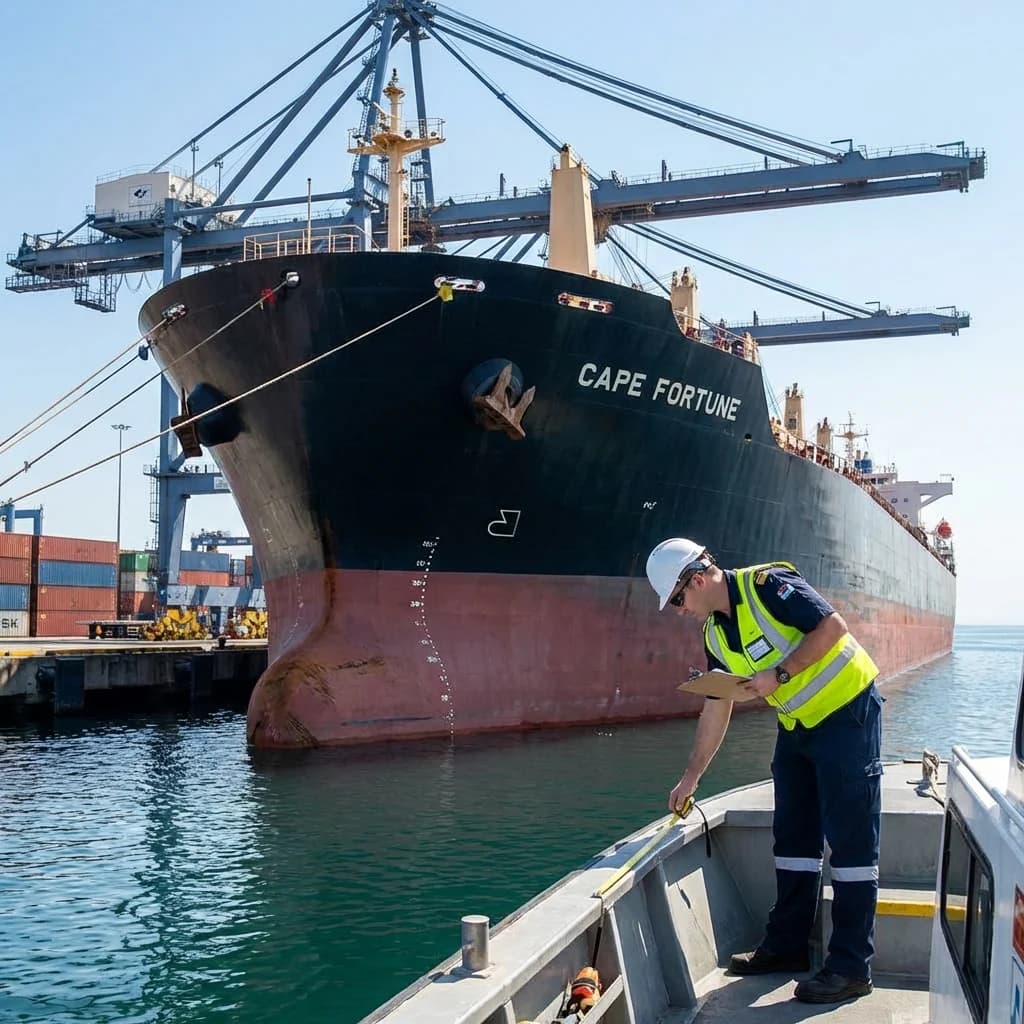
Draft survey is one of the most commercially sensitive operations on a bulk carrier. A difference of just 1 cm in draft reading can lead to a dispute of 50-100 tons of cargo, translating to thousands of dollars in claims.
In this complete guide for 2026, we will break down the entire draft survey process, from reading the draft marks to the final Excel calculation, ensuring you get the most accurate cargo figures every time.
The Principle: Archimedes in Action
The entire process relies on Archimedes' Principle:
"A ship floating freely in water displaces a volume of water equal in weight to the weight of the ship."
If we know the ship's weight before loading (Initial Survey) and after loading (Final Survey), the difference is the weight of the cargo loaded.
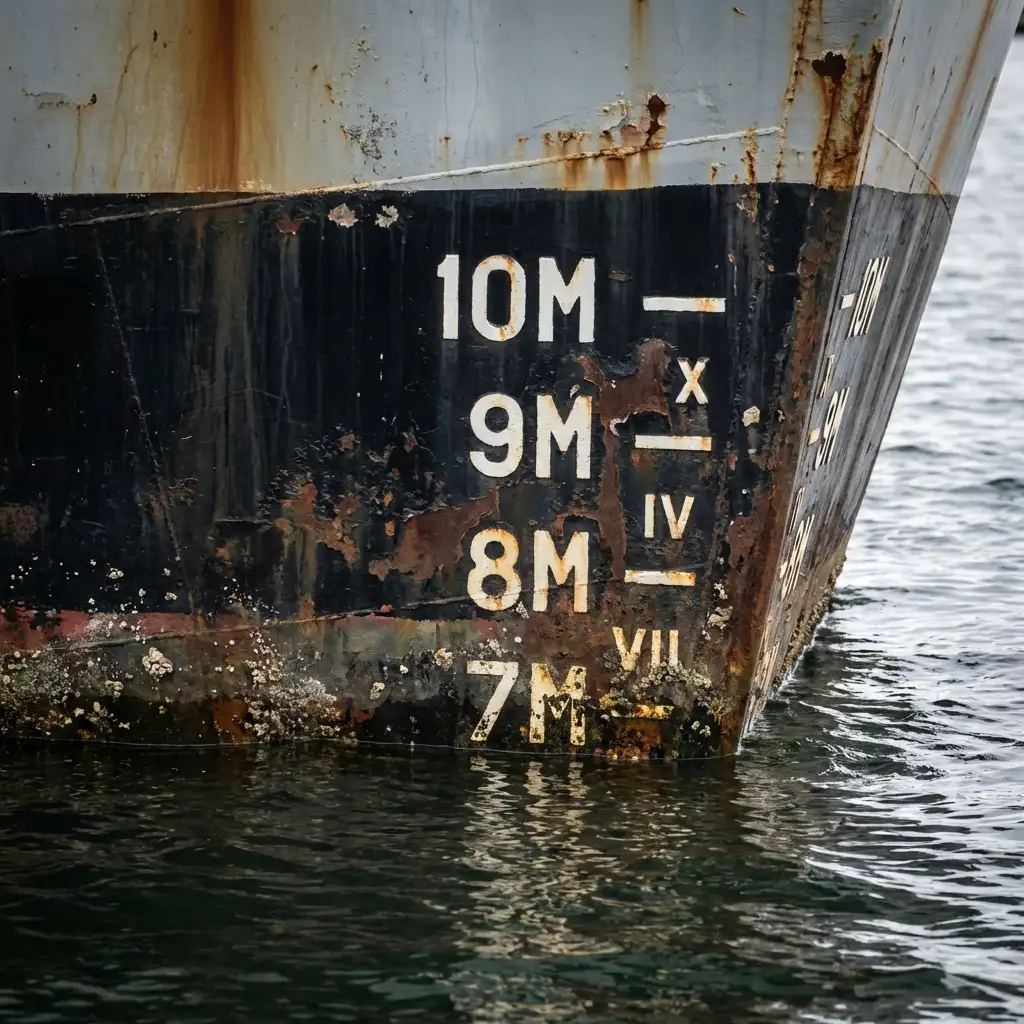
Step 1: Reading the Draft Marks
Accuracy starts here. You need to read six draft marks:
- Forward (Port & Starboard)
- Midship (Port & Starboard)
- Aft (Port & Starboard)
Pro Tip: If the water is choppy, use a "draft tube" (a clear plastic tube with a small weight) to dampen the wave action and get a stable reading.
Step 2: Perpendicular Corrections
Draft marks are rarely located exactly at the Forward Perpendicular (FP) and Aft Perpendicular (AP). You must correct your visual readings to the perpendiculars using the distance from the marks to the perpendiculars (found in the ship's Stability Booklet).
Correction = (Trim × Distance from Mark to Perp) / LBP
- If the mark is behind the perpendicular, add the correction if trimmed by stern.
- If the mark is forward of the perpendicular, subtract the correction if trimmed by stern.
Step 3: Calculate Mean of Means
To account for the ship's hull deformation (Hogging or Sagging), we don't just take a simple average. We use the Quarter Mean Draft (Mean of Means).
- Mean Forward = (Fwd Port + Fwd Stbd) / 2
- Mean Aft = (Aft Port + Aft Stbd) / 2
- Mean Midship = (Mid Port + Mid Stbd) / 2
- Mean of Means = (Mean Fwd + Mean Aft + (6 × Mean Midship)) / 8
This weighted average gives 75% importance to the midship draft, where most of the buoyancy is.
Step 4: Hydrostatic Displacement
Enter your ship's Hydrostatic Tables with the calculated Quarter Mean Draft to find the Displacement in Salt Water (Density 1.025).
Step 5: The Essential Corrections
You're not done yet. You must apply three critical corrections:
1. Trim Correction
Hydrostatic tables assume the ship is on an even keel. If the ship has trim, the actual underwater shape changes.
- First Trim Correction: Based on the shift of LCF (Longitudinal Center of Flotation).
- Second Trim Correction (Nemoto): accounts for the curvature of the hull (important for large trims > 1% of LBP).
2. Density Correction
The tables are for Salt Water (1.025). Your port is likely brackish (e.g., 1.015).
Actual Disp = Table Disp × (Observed Density / 1.025)
3. List Correction
If the ship is listed (leaning), the draft reading increases artificially.
Correction = 6 × (List in cm)² × (TPC / 100)
Note: This is usually negligible if list is small, but vital if significant.
Step 6: Deductibles (Net Weight)
To find the cargo weight, we must subtract everything else on board:
- Ballast Water: Sound all tanks and convert to weight using the observed ballast water density.
- Fuel Oil & Diesel Oil: From daily soundings.
- Fresh Water: From tank soundings.
- Constant: The known constant weight of the ship (stores, spare parts, mud in tanks).
Cargo Loaded = (Final Net Displacement) - (Initial Net Displacement)
Common Errors to Avoid in 2026
- Density Errors: Using a Hydrometer made for Draft Survey (glass) vs one for Load Line. Always use a calibrated Draft Survey Hydrometer.
- Ballast Density: Assuming ballast water is 1.025. It might be 1.010 if you ballasted in a river. Always measure it.
- Squat Effect: Reading drafts while a pilot boat passes or in strong currents can induce error.
Conclusion
Draft survey is an art refined by science. By following these 6 steps and applying corrections methodically, you protect your company from massive commercial losses.
For a faster solution, check out our upcoming Automated Draft Survey Calculator (Coming late 2026).
Looking for more operational tools? Try our ETA Calculator or GM Stability Calculator.